
The bottom line: Pipeline Attrition Syndrome is a B2B marketing pattern where lead volume stays steady or grows, but few leads become meetings, opportunities or closed deals. In healthcare technology, it is usually caused by four things: targeting roles without buying power, missing the buying committee, nurture that stops at the first sales call, and sales handoffs that lose context. It can be diagnosed in HubSpot with lifecycle conversion, job title, deal contact and time-in-stage reports.
What is Pipeline Attrition Syndrome?
Pipeline Attrition Syndrome is the gap between healthy lead generation and weak pipeline creation. Campaigns hit their numbers, but meetings are scarce, opportunities stall at evaluation, and sales starts saying the leads aren’t real.
It is harder to spot than a traffic drop or a falling open rate, because marketing dashboards still look healthy. It is also common: Forrester’s State of Business Buying research found that 86% of B2B purchases stall during the buying process. Breezy Hill Marketing sees it often in healthcare technology companies, and it is very treatable once the cause is identified. (New to this series? Start with this blog: Leads vs. Revenue.)
What are the symptoms of Pipeline Attrition Syndrome?
The five most common symptoms are:
- Lead volume is healthy, but the lead-to-meeting rate is low.
- Opportunities are created, then sit in early stages for months.
- Deals stall when they reach a wider group of stakeholders.
- Sales and marketing disagree about lead quality, and both have a point.
- Marketing reports look good while the pipeline forecast keeps slipping.
What causes leads not to turn into deals?
Four root causes account for most cases:
- Targeting the wrong roles. Content that attracts researchers, students, consultants and junior staff produces volume without buying power. These contacts have real interest but cannot sign a contract.
- Missing the buying committee. In healthcare, the person who finds you is rarely the person who approves the purchase, and clinicians want a bigger say: a symplr survey of 280+ healthcare leaders found 72% of clinicians want more influence over software purchases. If marketing reaches the champion but never the CFO, CIO or clinical leader, the deal stalls when it needs their support.
- Nurture that stops too early. Many programs nurture a lead only until the first sales call. The hardest part of a healthcare deal often comes after that meeting, when the champion must make the case internally.
- Handoffs that lose context. When a lead reaches sales without its history (content read, pages visited, the problem that brought them in), the first conversation starts cold. A Gartner survey found teams that share buyer journey insights are 2.3x more likely to see higher sales conversion rates.
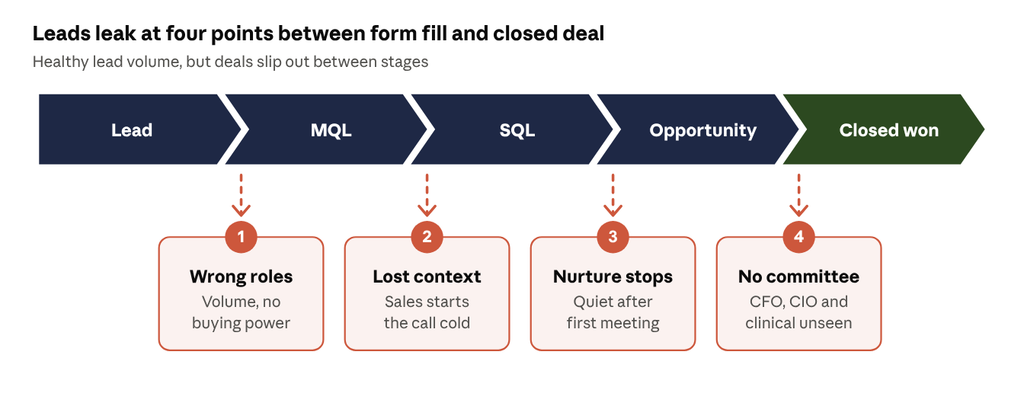
Where leads leak · 5 stages, 4 leak points
Each leak point maps to one root cause above and one fix in the treatment plan below.
Symptom, cause and fix at a glance
| Symptom | Likely cause | Fix |
| High lead volume, few meetings | Targeting roles without buying power | Shift from lead volume to account focus |
| Deals stall when more stakeholders join | Buying committee not reached | Build content and outreach for each committee role |
| Opportunities stuck after first meeting | Nurture stops at the first sales call | Nurture through the deal with champion enablement |
| Sales says leads “aren’t real” | Handoff loses context | Define qualification criteria, context and follow-up speed |
How do you diagnose Pipeline Attrition Syndrome in HubSpot?
Run these four HubSpot reports, in order:
- Conversion rate by lifecycle stage. Build a HubSpot funnel report and look for a sharp drop between MQL and SQL, or between SQL and opportunity.
- Job title and seniority of MQLs vs. closed-won contacts. If the two groups look very different, targeting is part of the problem.
- Contacts associated with open deals, by role. In a healthcare sale, a deal with only one associated contact is a warning sign.
- Time in each deal stage. Run HubSpot’s average time-in-stage report to see where deals typically slow down, then filter open deals by Time in current stage to find the ones stalled right now.
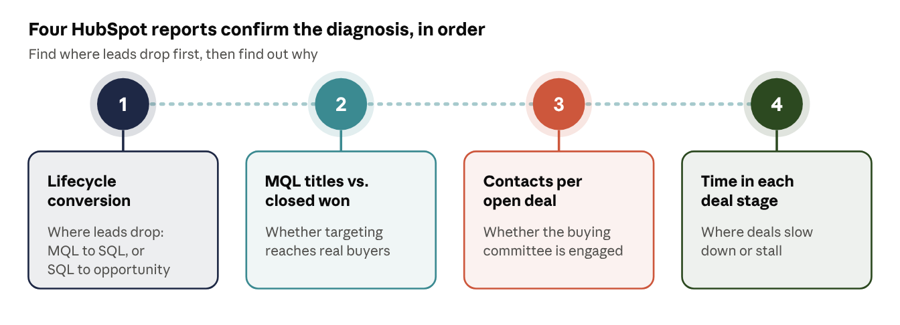
Diagnosis · 4 HubSpot reports
Start with the funnel to find where leads drop, then use the next three reports to learn why.
How do you fix Pipeline Attrition Syndrome?
The treatment usually combines four changes, one for each cause:
- Shift from lead volume to account focus. Define the accounts that matter and measure engagement across each account, not just individual leads.
- Build buying committee coverage. Create content and outreach for each role: the operational champion, the financial approver, the technical evaluator and the clinical voice.
- Nurture through the deal, not just to it. Give champions what they need to sell internally, such as ROI framing, security documentation and implementation timelines.
- Define the handoff. Agree on what qualifies a lead for sales, what context travels with it, and how quickly sales follows up.
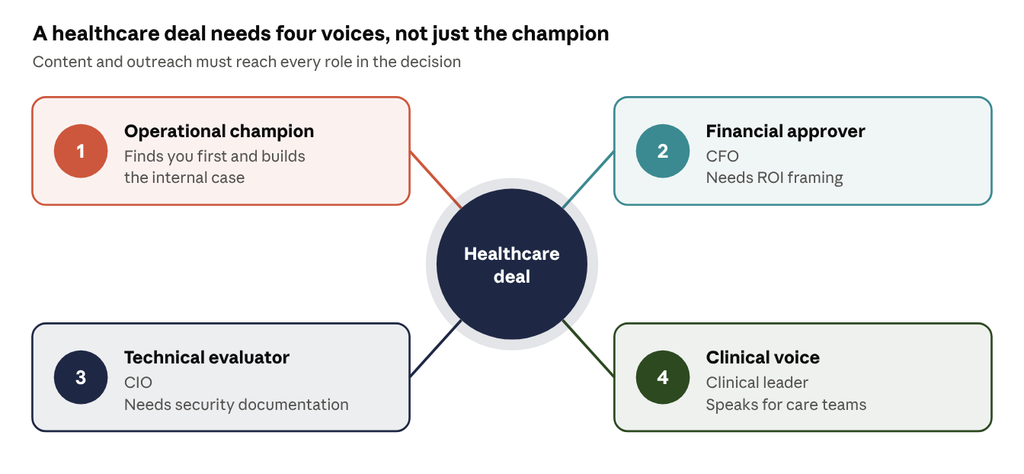
Buying committee · 4 roles
Marketing that reaches only the champion leaves three of these four voices without what they need to say yes.
When should you bring in outside help?
Bring in outside help when your team is too busy delivering the current plan to review the whole funnel. Breezy Hill Marketing’s Pipeline Reality Diagnostic is a four-week engagement that reviews your HubSpot data, maps where deals are lost, and delivers a prioritized plan to fix it. You keep the plan and the decisions; we bring the outside view and HubSpot depth.
Learn about the Pipeline Reality Diagnostic
Frequently asked questions
Is Pipeline Attrition Syndrome a lead quality problem? Partly. Lead quality is usually a symptom. The underlying causes are targeting, buying committee coverage, nurture length and handoff process.
What is a normal number of contacts on a healthcare technology deal? More than one. A healthcare deal typically needs an operational champion, a financial approver, a technical evaluator and a clinical voice. A deal with a single associated contact is at higher risk of stalling.
Which HubSpot report should I run first? Start with conversion rate by lifecycle stage. It shows where in the funnel leads drop off before you investigate why.
How long does it take to diagnose? A focused review can be done in weeks. Breezy Hill Marketing’s Pipeline Reality Diagnostic runs four weeks from data review to prioritized plan.
Does this only affect healthcare technology companies? No. It appears in any complex B2B sale with multiple decision-makers, but it is especially common in healthcare because buying committees are large and include clinical, financial and technical roles.
Want help putting this to work?
We work alongside healthcare marketing teams. Discovery calls take 30 minutes.