The short answer: Boards want to know what marketing produces in revenue, not how many leads it generates. Healthcare marketing leaders should report five things: current pipeline value, marketing-sourced and influenced revenue, where deals stall, customer acquisition cost, and a pipeline-based forecast. If you use HubSpot, each of these comes from standard reports, once lifecycle stages, deal stages, contact associations, and campaign tracking are set up correctly.
Why don’t MQLs matter to healthcare boards?
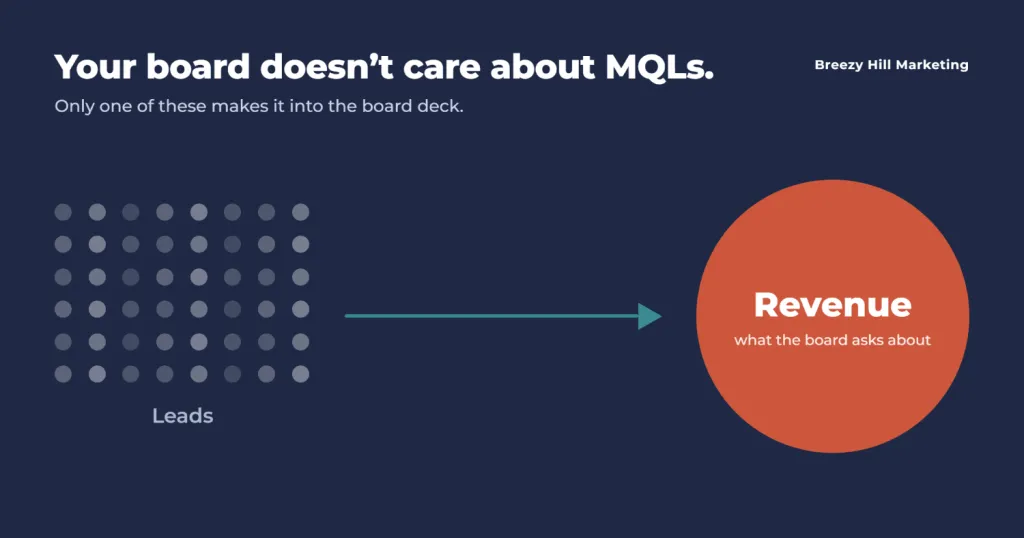
Every quarter, healthcare marketing leaders walk into board meetings with a slide full of lead numbers. Form fills are up. MQLs beat the target. Webinar registrations look strong.
And every quarter, someone asks a version of the same question: “So what did that do for revenue?”
Boards care about what marketing produces. McKinsey’s CMO Growth Research found that most CEOs judge marketing by revenue growth and margin, yet far fewer CMOs put those metrics first. In healthcare, the gap between a lead and a closed deal can run months or quarters. If your reporting stops at the lead, you leave out the part of the story leadership cares about most.
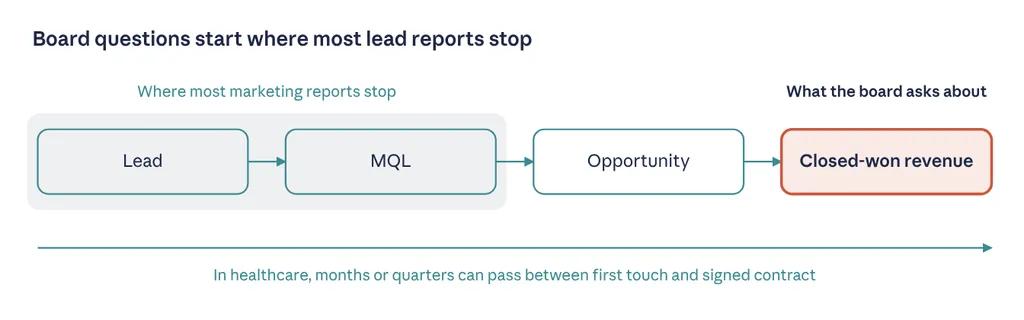
Lead to revenue · where reporting usually stops
Why is marketing reporting harder in healthcare?
Healthcare sales cycles are longer and involve more decision-makers than most B2B markets. In many industries, a lead becomes an opportunity in weeks and closes within a quarter. Healthcare rarely works that way. Gartner’s research on healthcare buying journeys points to diverse buying groups and organizational change as key sources of complexity. It’s the reality every healthcare technology company selling to health systems faces.
- Health systems: a purchase can involve the CIO, CFO, clinical leaders, IT security, legal, and procurement.
- Payers and employers: each adds its own layers of review.
- Timing: a contact who downloads your guide in January may not appear on a signed contract until fall.
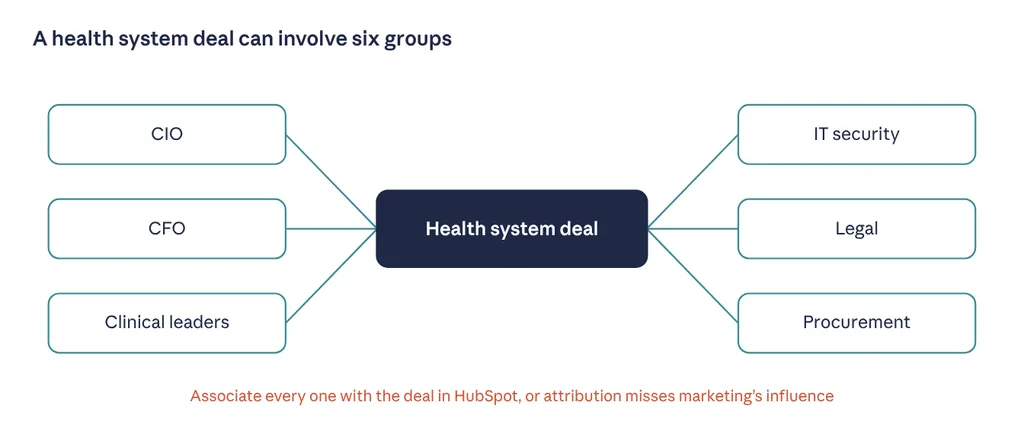
Healthcare buying committee · six stakeholder groups
That timeline makes lead counts feel productive while telling leadership almost nothing about whether marketing is working.
What marketing metrics do boards want to see?
Strip away the slide formatting, and most board and CEO questions about marketing come down to five things:
- What’s in the pipeline right now? Total value and number of open deals, compared with last quarter.
- How much did marketing source or influence? Not just first touch, but which programs touched the contacts on active deals.
- Where are deals getting stuck? Which stages hold deals longest, and where deals are lost.
- What does it cost to win a customer? Marketing and sales spend compared with new revenue.
- What should we expect next quarter? A forecast grounded in pipeline, not a hopeful lead target.
Which HubSpot reports answer the board’s questions?
If you’re on HubSpot, every one of these questions can be answered from data you already collect, as long as the foundation is in place.
| Board question | HubSpot report | What to filter or compare |
|---|---|---|
| What’s in the pipeline? | Deal pipeline report by stage and close date | Current and next quarter |
| What did marketing source or influence? | Attribution reports | Contacts, companies, and campaigns tied to deals |
| Where are deals stuck? | Time in stage and deal stage conversion reports | Stage-by-stage drop-off |
| What does a customer cost? | Custom report | Campaign spend vs. closed-won revenue |
| What’s next quarter? | Forecasting tools | Weighted by stage probability |
None of these reports are exotic. HubSpot documents how to build attribution reports and set up its forecast tool. The problem is that most portals can’t produce them reliably, which is the gap our HubSpot marketing ops work closes.
What has to be true in your HubSpot data first?
Accurate board reporting depends on four data basics that are easy to let slide.
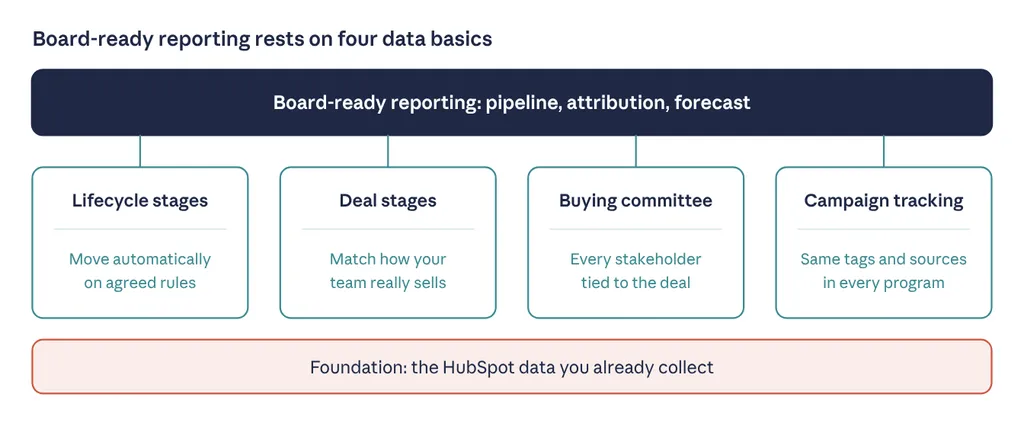
HubSpot data foundation · four basics
1. Lifecycle stages are maintained
Contacts should move from lead to opportunity to customer automatically, based on rules your sales and marketing teams agree on. HubSpot can update lifecycle stages automatically based on record associations or workflows.
2. Deal stages match how you sell
If your sales process has six steps and HubSpot still has the default seven, reps will guess, and your data will show it.
3. The whole buying committee is associated with deals
In healthcare, that means every stakeholder, not just the champion. Without those associations, attribution can’t see marketing’s influence. It’s also why effective healthcare demand generation targets the whole committee, not one contact.
4. Campaigns and sources are tracked consistently
Tracking links, campaign tags, and source properties should be used the same way across every program.
When those are in place, the board conversation changes. Instead of defending a lead number, you show which programs moved which deals.
Frequently asked questions
What is the difference between an MQL and pipeline?
An MQL (marketing qualified lead) is a contact who meets marketing’s criteria for sales follow-up. Pipeline is the dollar value of open deals that sales is actively working. Boards focus on pipeline because it connects directly to revenue.
What is marketing-influenced revenue?
Marketing-influenced revenue is closed-won revenue from deals where at least one associated contact engaged with a marketing program at any point. Marketing-sourced revenue is narrower: deals where marketing created the first touch.
How long is a typical healthcare B2B sales cycle?
Healthcare sales cycles often run six to eighteen months, depending on deal size and buyer type. Health system purchases tend to run longest because of the number of stakeholders and review steps.
Can HubSpot track the full healthcare buying committee?
Yes. HubSpot lets you associate multiple contacts with a deal and label their roles. Associating every stakeholder is what allows attribution reports to show marketing’s full influence.
How does Breezy Hill Marketing build board ready reporting in HubSpot?
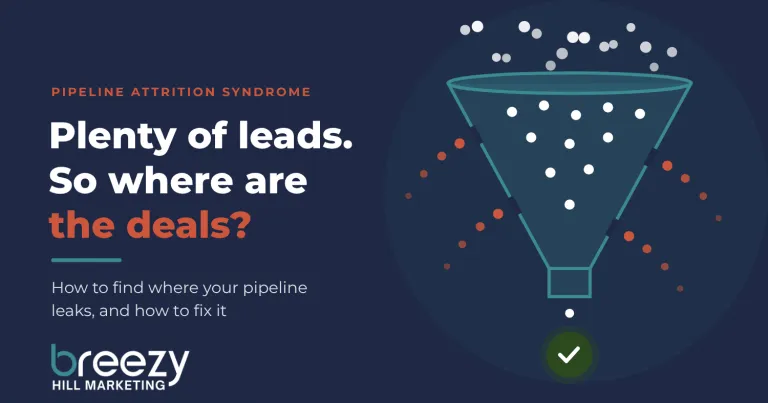
Most healthcare marketing teams are closer to board-ready reporting than they think. The data is often there; it needs cleanup, a few settings changed, and reports built for the questions leadership actually asks. For a deeper look at whether your pipeline numbers hold up, see the Breezy Hill Pipeline Reality Diagnostic.
Want to know where your portal stands? Breezy Hill Marketing will run a HubSpot audit at no cost. You’ll see which of these reports you can build today, what’s missing, and what it would take to close the gap. Your team keeps the plan; we help you show what it’s producing.

Want help putting this to work?
We work alongside healthcare marketing teams. Discovery calls take 30 minutes.