HubSpot is earning its cost when your team can tie marketing programs to closed revenue in minutes. If it mostly sends email and stores contacts, you’re paying for capability you aren’t using. The 15-point checklist below shows where your portal stands across data quality, lifecycle management, automation, pipeline, and attribution.
Here’s a quick test. If your CEO asked which marketing programs influenced last quarter’s closed deals, could you pull the answer from HubSpot in ten minutes?
If yes, you’re ahead of most portals we see. If no, you’re in good company. Many healthcare companies pay for HubSpot Professional or Enterprise and use it mostly for email and contact storage. The platform can be customized to match how you actually sell, and closing that gap is one of the fastest ways to get more value from a tool you already pay for.
How do you know if HubSpot is worth the cost?
HubSpot is worth the cost when it does three things reliably:
- Keeps clean, complete records your team trusts.
- Moves leads to sales automatically, with clear rules.
- Connects marketing activity to pipeline and closed revenue.
If any of these is weak, the checklist will show you where.
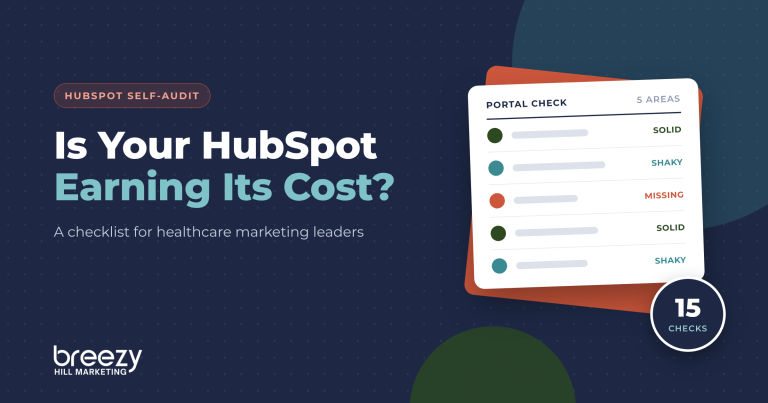
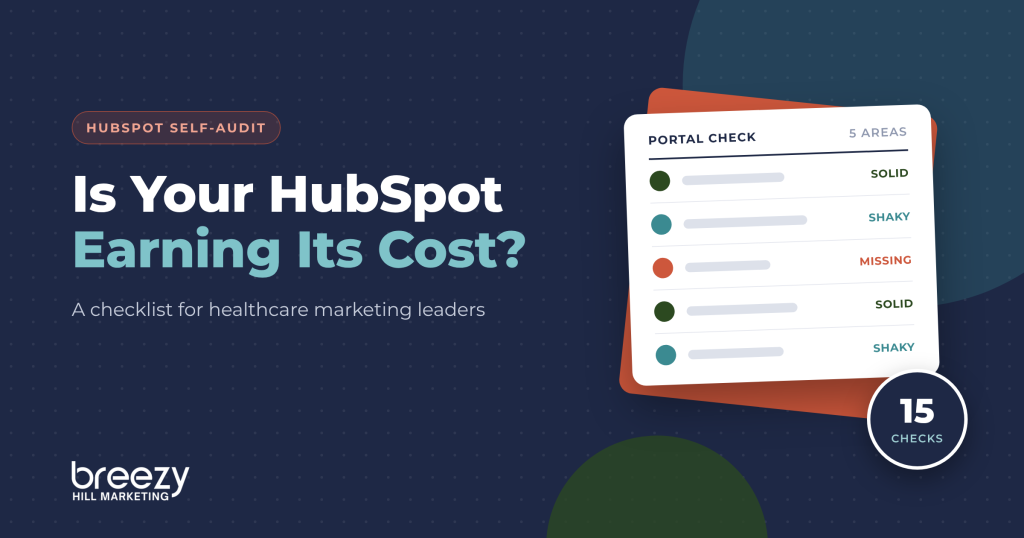
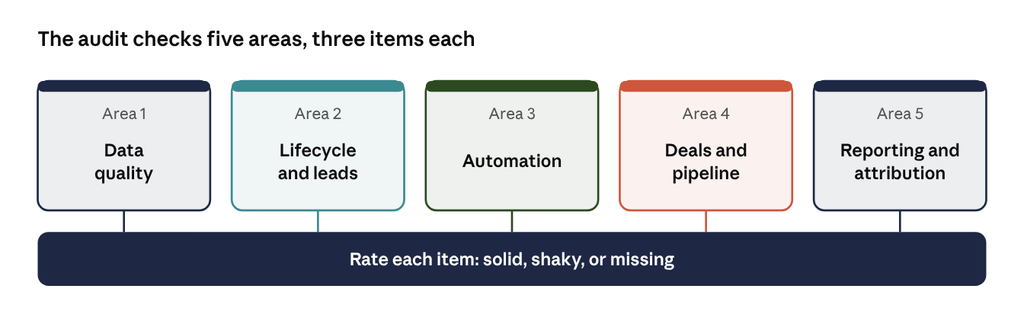
The HubSpot self-audit checklist
Mark each item solid, shaky, or missing.
HubSpot self-audit · 5 areas, 15 checks
1. Data quality
- Duplicate contacts and companies are rare, and there’s a process for merging them.
- Job title, company, industry, and lifecycle stage are filled in for most contacts.
- Properties nobody uses have been archived.
2. Lifecycle and lead management
- Lifecycle stages update automatically based on clear rules.
- Lead scoring reflects both fit and engagement, and sales trusts it.
- There’s a defined lead handoff to sales, with alerts and follow-up expectations.
3. Automation
- Workflows are documented, clearly named, and reviewed at least once a year.
- Nurture programs exist for different roles and stages, not one general track.
- Sales uses sequences for consistent outreach.
4. Deals and pipeline
- Deal stages match your actual sales process.
- Buying committee contacts are associated with deals.
- Required properties keep deal information consistent.
5. Reporting and attribution
- Campaigns are tracked consistently across channels.
- Attribution reports connect marketing activity to closed revenue.
- Leadership dashboards focus on pipeline and revenue, not just activity.
How to read your results
| Your result | What it means | Next step |
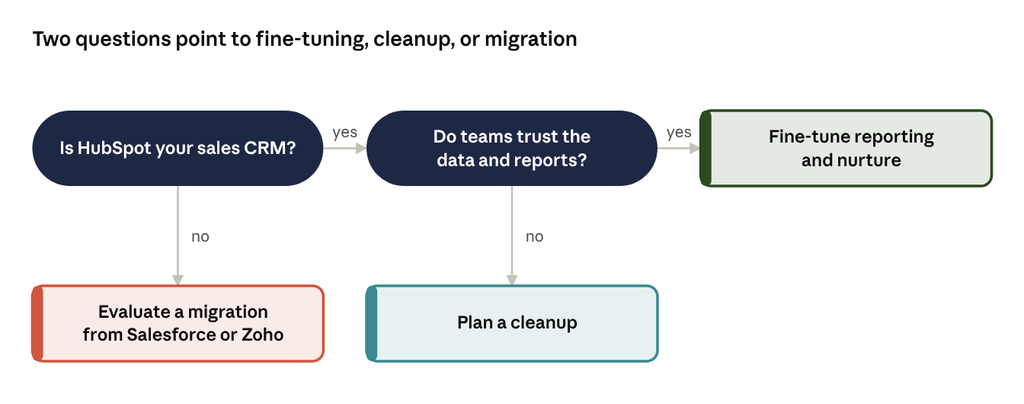
| Mostly solid | Your portal is working | Fine-tune reporting and nurture |
| Several shaky or missing | Clutter is costing you | Plan a cleanup and optimization |
| Sales lives in another CRM | No one sees the full journey | Evaluate a migration to HubSpot |
Cleanup or migration · 2 questions, 3 outcomes
When does a HubSpot portal need a cleanup?
A HubSpot portal needs a cleanup when your team no longer trusts the data or reports. Common signs:
- Thousands of duplicate records.
- Properties named things like “Old Lead Source 2.”
- Workflows that fire, but nobody remembers why.
- Reports leadership has stopped using.
This is normal. Portals collect clutter as teams change, campaigns come and go, and tools are connected and disconnected. Cleanup and optimization is a defined project with a clear end, and the payoff is a system your team can rely on again.
When should you migrate from Salesforce or Zoho to HubSpot?
Consider a migration when your current CRM costs more in licenses, admin time, and workarounds than it delivers. The clearest sign: marketing uses HubSpot for email while sales works in Salesforce or Zoho, and no one can see the journey from first touch to closed deal. Done well, a migration brings marketing, sales, and service into one system with reporting that connects them.
What do healthcare companies need from HubSpot?
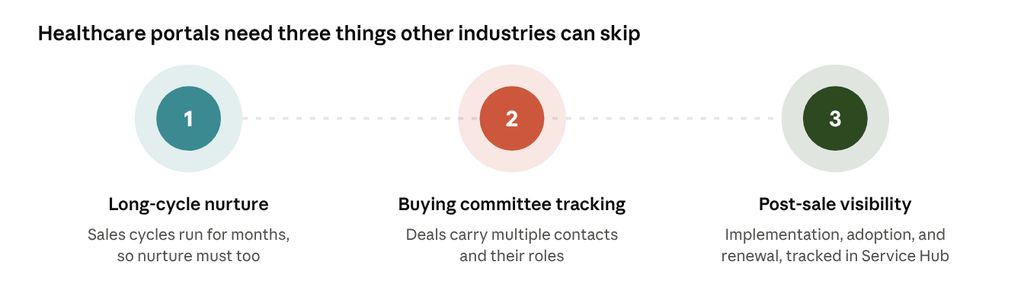
Healthcare companies need three things from HubSpot that many other industries can skip:
- Long-cycle nurture. Sales cycles run for months, so nurture programs must too.
- Buying committee tracking. Deals need multiple contacts and roles associated. Gartner research on healthcare buying points to diverse buying groups as a core source of complexity.
- Post-sale visibility. For healthcare technology companies, implementation, adoption, and renewal matter as much as the first sale. Service Hub, customized to how you serve customers, shows which service programs are working and which need attention.
Healthcare HubSpot needs · 3 requirements
Frequently asked questions
What is a HubSpot audit? A HubSpot audit is a review of your portal’s data, automation, pipeline, and reporting to find what’s broken, unused, or underperforming, and what to fix first.
How long does a HubSpot cleanup take? It depends on portal size and how many issues the audit finds. Cleanup is a scoped project with a defined end, not an ongoing cost.
Is HubSpot a good CRM for healthcare companies? Yes, when it’s configured for long sales cycles, buying committees, and post-sale service. Out of the box, most portals aren’t.
Should I clean up my portal or migrate to HubSpot? Clean up if HubSpot is already your CRM but the data and reports aren’t trusted. Evaluate migration if sales and marketing work in separate systems.
Get the full picture
A self-audit tells you where to look. A full audit tells you what to fix first. Breezy Hill Marketing will review your HubSpot portal at no cost and show you where it’s falling short of what you’re paying for, and what it takes to close the gap.

Want help putting this to work?
We work alongside healthcare marketing teams. Discovery calls take 30 minutes.