You have built a product that hospitals and health systems actually want. Now the question everyone on your leadership team is asking: do we hire a VP of Marketing or bring on an agency? Breezy Hill Marketing helps health tech teams work through exactly this kind of decision, matching marketing structure to business stage and sales complexity.
The seven questions below can guide that conversation. Each one connects to the realities of selling into healthcare: long buying cycles, compliance-heavy messaging, and deals that involve a dozen stakeholders before a contract is signed.
Should you hire a VP of Marketing or a health tech marketing agency?
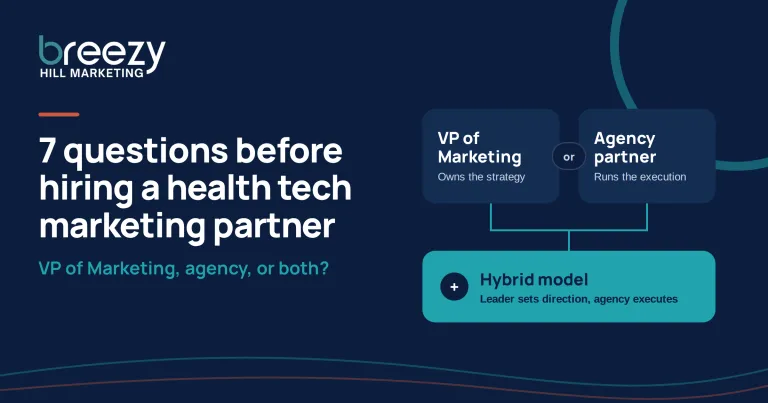
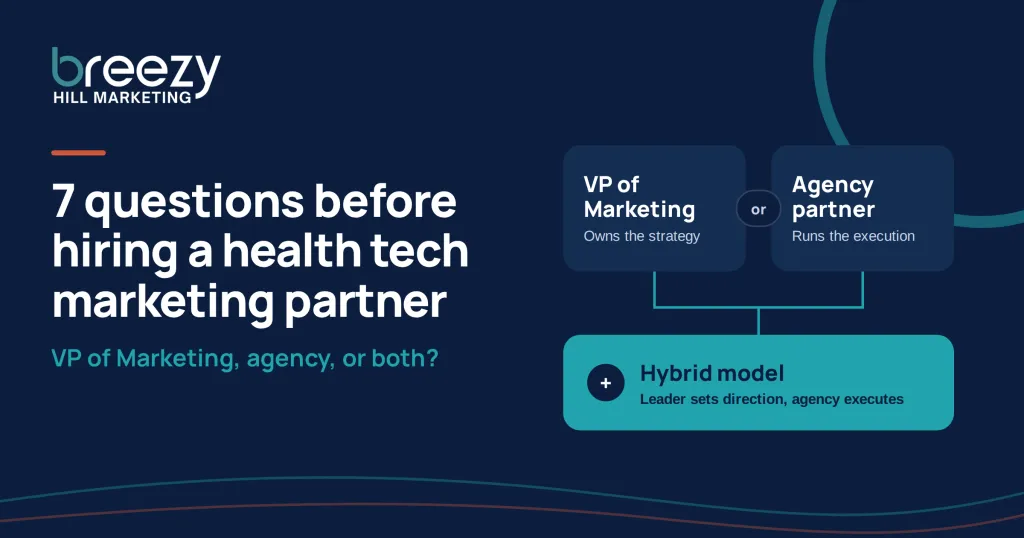
It depends on what you are missing. Hire a VP of Marketing if you need someone to own strategy, positioning, and executive reporting. Hire a health tech marketing agency if your strategy is set and you need execution, specialized skills, and flexible capacity. Many growing health tech companies use both: an internal leader to set direction and an agency to execute.
Key Takeaways: Hiring a Health Tech Marketing Partner
- Define whether you need strategic leadership, execution capacity, or both before committing to a marketing model.
- Healthcare compliance requirements directly shape which marketing functions can be outsourced safely and which stay internal.
- Budget comparisons should include the total cost of hiring, onboarding, benefits, turnover risk, and ramp-up time.
- Breezy Hill Marketing brings specialized health tech marketing expertise to your team without long-term headcount commitments or overhead.
- A hybrid approach combining internal leadership with agency execution often gives growing health tech companies the flexibility to scale.
Deciding Between a VP of Marketing and a Health Tech Agency
1. Do You Need a Strategist, an Executor, or Both?
A VP of Marketing owns the roadmap: positioning, messaging frameworks, go-to-market planning, and board-level reporting. An agency picks up where strategy meets production, running campaigns, building content, managing SEO, and tracking performance.
If your CEO is still setting marketing direction and you need hands on keyboards, an agency fills that gap faster. If nobody internally can translate product capabilities into a market narrative, a VP might be the first hire. Many health tech companies discover they need both. Starting with an agency buys you time to find the right executive.
2. Can Your Budget Support a Full-Time Marketing Leader?
A VP of Marketing in health tech typically commands a six-figure salary plus benefits, equity, and performance bonuses. Factor in recruiting fees and onboarding time, and the first year of that hire can stretch well beyond base compensation.
An agency engagement converts that fixed cost into a flexible monthly investment. You can redirect spend toward demand generation or content production as priorities shift quarter to quarter. For companies between Series A and Series C, that flexibility often determines how quickly your pipeline grows.
3. Does Your Partner Understand Healthcare Compliance?
Marketing in regulated industries adds layers that general B2B marketers rarely encounter. Claims need clinical review. Patient data has to stay out of ad platforms. And messaging to hospital CIOs requires a different register than messaging to practice managers.
Ask any candidate, whether it is an individual hire or an agency, to walk you through a recent compliance challenge they navigated. A qualified health tech marketing partner will reference specific scenarios: FDA-adjacent language reviews, HIPAA guardrails on tracking pixels, or stakeholder approval workflows for clinical claims.
4. How Will You Handle the Long Sales Cycles in Health Tech?
Enterprise health tech deals often run 12 to 18 months from first touch to closed contract. That timeline demands consistent nurture campaigns, multi-format content for different buying committee members, and attribution models that track influence across dozens of touchpoints.
A VP can own the pipeline narrative internally. But building the infrastructure to support it, including marketing automation, lead scoring, and reporting dashboards, requires specialized execution. Agencies with real health tech experience bring those systems ready to go from day one of the engagement.
5. Do You Need Specialized Skills You Cannot Staff Internally?
Health tech marketing pulls from a wide skill set: SEO and AEO optimization, paid media, account-based marketing, video production, and CRM configuration. Hiring one person who covers all of these at an expert level is unrealistic.
Agencies assemble cross-functional teams around your specific needs. If Q1 calls for a heavy content push and Q3 shifts toward ABM, an agency reallocates without a hiring cycle. According to the Gartner 2025 CMO Spend Survey, 59% of marketing leaders say they lack the budget to execute their strategy. Those respondents were mostly at companies with more than $1 billion in revenue, so even marketing teams at that scale are stretched, which makes flexible resource allocation a real advantage for leaner health tech teams.
6. How Will You Measure Marketing Performance and Accountability?
A VP of Marketing reports to the C-suite and owns the marketing number. That clear line of accountability matters when your board asks who is responsible for pipeline growth. But accountability without execution infrastructure can create a bottleneck fast.
Agencies bring built-in reporting frameworks tied to CRM data that connect marketing activity to revenue outcomes. Breezy Hill Marketing builds HubSpot-native dashboards that show qualified pipeline by source. Your leadership team gets the visibility they need without adding headcount to build those reports.
7. What Happens When Your Priorities Shift Mid-Year?
Health tech companies deal with shifting priorities all the time: a new product launch, a competitive response, a regulatory change that rewrites your messaging overnight. A VP can pivot strategy, but expanding or contracting the team underneath takes months.
An agency model gives you access to a broader bench of specialists who can spin up new work quickly. Need a video campaign for a conference next quarter? An agency can staff it without a job posting. That kind of responsiveness matters when your market moves faster than your hiring timeline.
How to Choose the Right Marketing Model for Your Health Tech Company
The VP-versus-agency question is rarely an either-or decision. Many of the most effective health tech marketing programs run a hybrid model: a senior internal leader who sets direction paired with an agency partner who provides execution depth and specialized skills.
Start by mapping your current gaps. If you lack strategic leadership, hiring a VP or fractional CMO might be the right first move. If you have a clear strategy but need the team to execute it, an agency partner like Breezy Hill Marketing gives you specialized health tech marketing support without the overhead of building a full department.
VP of Marketing vs. agency vs. hybrid: which model fits?
VP of Marketing: Best when you need someone to own strategy, positioning, and board reporting. It carries the highest fixed cost and is the slowest way to add new skills.
Agency partner: Best when your strategy is set and you need execution, specialized skills, and flexible capacity. It starts faster and scales up or down without a hiring cycle.
Hybrid model: Best for growing health tech companies that need both. An internal leader sets direction while an agency handles specialized execution.
Whatever path you choose, weigh your decision against the buying cycles, compliance demands, and stakeholder complexity that define health tech sales. The right partner understands those realities and builds programs that work within them.
FAQs About Hiring a Health Tech Marketing Partner
What is the main difference between a VP of Marketing and a marketing agency?
A VP of Marketing owns your overall strategy, budget allocation, and executive reporting. An agency provides execution, specialized skills, and flexible capacity to run campaigns, produce content, and manage channels.
When should a health tech company hire a VP of Marketing instead of an agency?
Hire a VP when your company needs a senior leader to own positioning, build internal processes, and represent marketing at the executive level. This role is most valuable when strategy direction is unclear and needs dedicated internal ownership.
How does Breezy Hill Marketing support health tech companies specifically?
Healthcare is all Breezy Hill Marketing does. Breezy Hill Marketing provides HubSpot implementation, demand generation, SEO/AEO, and content strategy tailored to B2B healthcare IT. The team understands long sales cycles, compliance requirements, and multi-stakeholder buying committees common in health tech.
Can you use both a VP of Marketing and a marketing agency at the same time?
Yes. A hybrid model is common in health tech. The VP sets direction and manages vendor relationships while the agency handles specialized execution like paid media, content production, and marketing automation workflows.
What compliance considerations matter when choosing a health tech marketing partner?
Your marketing partner should understand HIPAA requirements for patient data in advertising, FDA-adjacent language rules for clinical claims, and the multi-level approval workflows common in healthcare marketing. Ask for specific examples of compliance-related challenges they have navigated.
How do you evaluate whether a marketing agency has real health tech experience?
Request named case studies from healthcare IT or health tech clients. Ask about their experience with health system buying committees, regulatory messaging review, and CRM attribution across long sales cycles. Agencies with genuine expertise will reference specific workflows and measurable results.
Why choose a healthcare specialist agency over a generalist?
A specialist already knows healthcare buying committees, compliance review, and long sales cycles, so there is far less ramp up time. Healthcare is all Breezy Hill Marketing does, so every strategist and specialist on your account works only with healthcare companies.
Should a health tech company hire a fractional CMO instead of a VP of Marketing?
A fractional CMO is a part time senior marketing leader. It can be the right fit when you need strategic direction but are not ready for a full time executive salary, and it pairs well with an agency that handles execution.

Want help putting this to work?
We work alongside healthcare marketing teams. Discovery calls take 30 minutes.