Right now, your buyers are asking AI tools to shortlist vendors and partners before they ever reach your site. If your content only defines and describes, you’re handing the decision to someone else.
Most healthcare marketing content is built to explain things like what a category is, how a technology works, and why a regulation matters. That’s useful groundwork. But answer engines like ChatGPT, Perplexity, and Google AI Overviews are no longer just looking for explanations.
They are looking for content that helps a buyer choose. When your content stops at “here’s what this is,” AI systems fill the gap with whatever third-party source does the comparing for you.
Healthcare is more exposed to this than almost any other sector. AI Overviews now appear on 48.7% of healthcare-related Google queries. That’s the highest rate among the ten industries Conductor benchmarked because healthcare questions tend to be complex and multi-layered.
HubSpot also reported that its customers saw a 27% year-over-year decline in organic traffic, even as AI referral traffic tripled industry-wide. They also found that LLM-sourced visitors converted 4.4x better than traditional organic visitors.
So fewer visitors, but far more valuable ones.
Look at who AI actually cites on healthcare topics
mayoclinic.org (6.58% share), clevelandclinic.org (4.90% share), healthline.com (4.42% share), goodrx.com (3.61%), and webmd.com (3.37%).
ChatGPT drives 83.8% of all that AI referral traffic in healthcare. Perplexity accounts for just about 8%. So if you only track one engine, track ChatGPT.
News content is the single most-cited page type (46,000+ cited pages), followed by blogs (36,000+). That means you can leverage your blog content to drive AI referral traffic. It just has to be the kind AI likes to use.
Your buyer’s questions are rarely “What is X?” They’re often “Which X should we pick, and why?” Prompts submitted to AI engines average 23 words, compared with 3.37 words for a traditional search query.
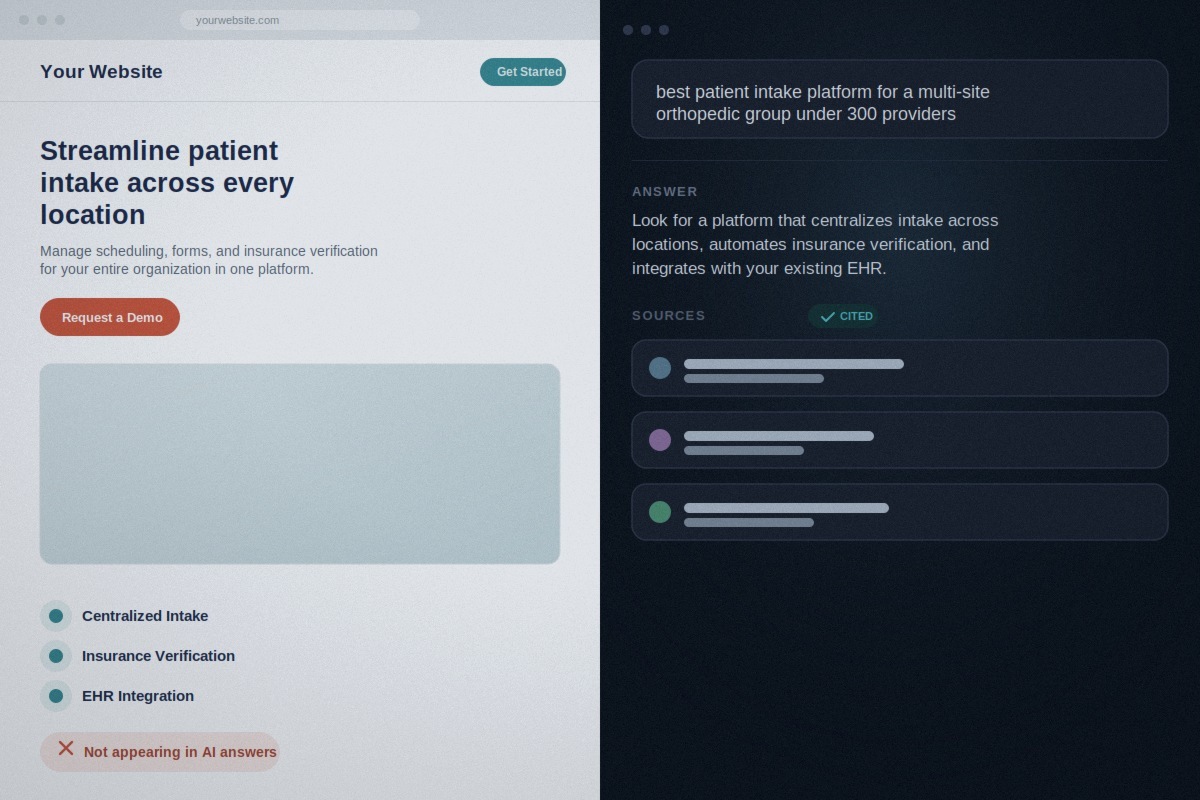
People are describing their exact situation, not typing a keyword. A prompt like “best patient intake platform for a multi-site orthopedic group under 300 providers” carries buying intent. If nothing on your site answers the question your customer wants answered, you’re invisible at the exact moment they’re ready to buy.
Explain vs. decide
| EXPLAIN CONTENT | DECIDE CONTENT |
| Definitions (e.g., “what is value-based care?”) | Named trade-offs and evaluation criteria |
| Feature and capability overviews | “When to choose X over Y” framing |
| General how-it-works explainers (e.g., “how remote patient monitoring works”) | Comparisons with evaluation logic |
| Regulatory background and context | Cost, staffing, integration, and risk considerations |
Content that only explains gets read. Content that helps someone decide gets cited and gets your organization named in AI answers.
How to run your own AEO audit
Pull your ten highest-traffic pages and score each one honestly against the following questions.
FIVE-POINT AEO AUDIT
- Does this page answer “which one” as clearly as it answers “what is”?
- Are trade-offs named specifically or just implied?
- Would an AI engine find an answer worth using here?
- Is the content structured with scannable subheads and criteria, not one long block?
- If a competitor’s page were substituted in, would the AI’s answer actually change?
Most healthcare sites pass questions 3 and 4 and fail 1, 2, and 5.
Question 1 is about decision usefulness. Your page should help the searcher choose, not just understand.
Question 2 is about specificity. Spell out the trade-offs, including when one option makes more sense than another.
Question 3 is about citation-worthiness. Your content should have self-contained information that AI can confidently draw from, such as a recommendation, statistic, comparison, or conclusion. AI rarely repeats sentences verbatim, so that’s not the goal. Focus on making the underlying information specific, useful, and well-supported enough to be worth using.
Question 4 is structure. Make your answers easy to find and digest with descriptive subheads, tables, and clearly defined criteria.
Question 5 is differentiation. Add something meaningful that would disappear if a competitor’s page replaced yours. This can be original experience, proprietary data, a specific recommendation, or a point of view grounded in what your organization knows.
We have an AEO Audit Template to help you get started!
Where HubSpot’s AEO tools fit
The audit above tells you what to fix. It doesn’t tell you whether what you did worked, or which AI engines are naming your competitors instead of you. That requires measurement.
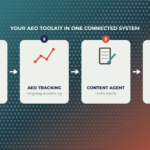
HubSpot AEO tracks how your brand appears inside AI-generated answers across ChatGPT, Gemini, and Perplexity.
Here’s how its features align with your AEO goals.
| What you need to know | HubSpot AEO feature |
| Are we showing up in AI answers at all? | Brand Visibility Score – how often you appear, as a percentage |
| Which buyer questions are we winning or losing? | Prompt Tracking – monitors specific prompts, suggested from your own CRM and competitor data |
| Who is being cited instead of us? | Citation Analysis – the domains, pages, and content types AI pulls from |
| How do we compare to named competitors? | Share of Voice and Competitor Visibility Tracking – shows how your AI visibility compares with named competitors |
| Is AI describing us accurately and favorably? | Sentiment Analysis – scored from -100 to +100 |
| What should we do first? | Prioritized Recommendations – ranked content, technical, video, and third-party outreach actions |
HubSpot AEO is bundled with Marketing Hub Professional and Enterprise, offering expanded prompt volume and CRM-powered recommendations. There’s also a standalone version at $50/month that includes 25 tracked prompts, plus a no-credit-card trial across all three engines.
Three ways to use HubSpot AEO in Healthcare
1. Find out who owns your category in AI answers
Track the prompts your referral sources and buying committees would actually type, such as “best care coordination platform for a rural health system” or “alternatives to [competitor] for ambulatory surgery scheduling.”
Citation Analysis will show whether AI is citing you, a competitor, or a third-party review site. If the answer is consistently WebMD or an industry publication, you have decision-content gaps.
2. Correct the record when AI describes you wrong
Sentiment Analysis surfaces cases where an engine mischaracterizes your organization, such as an outdated service line, a discontinued product, or a stale accreditation detail.
Trust drives decisions in healthcare, so a wrong AI answer is a material problem. Knowing about it is the first step to publishing content that overwrites it.
3. Prove the channel to a skeptical board
HubSpot cites early customers including Docebo, generating nearly 15% of leads from AI traffic. Sandler saw 8,000 new visitors within weeks and 12 new account conversions. Those are not healthcare organizations, but they show the power of winning in AI search.
The traffic from AI search is high-intent and measurable with HubSpot AEO. A Brand Visibility Score trending upward quarter over quarter is a metric a non-technical executive audience can act on.
A note on compliance
AEO work involves your public marketing content, such as blog posts and service pages.
No protected health information is involved, which keeps this initiative well clear of the compliance review that slows most healthcare marketing projects.
HubSpot also now offers a Business Associate Agreement to covered entities. If your team intends to handle PHI anywhere on the platform, confirm the current scope and any required add-ons directly with HubSpot before you start.
You don’t have to scrap your explainer content. You need to add the decision side to it.
Add small, specific additions that give a buyer and the AI tool reading on their behalf something concrete to act on.
Do that across your highest-intent pages first. That’s where the AEO gap is costing you the most, and where fixing it pays off fastest. Then measure it, so the next round of content decisions is based on what AI is actually doing rather than what you hope it is.
The search landscape has changed. Many organizations are already watching organic traffic decline as AI takes over more of the searches buyers used to make on Google. The time to address AEO gaps is now, before it becomes a bigger problem.
Are you ready to run a full AEO audit of your site, mapped page by page?
Email our in-house AEO expert!