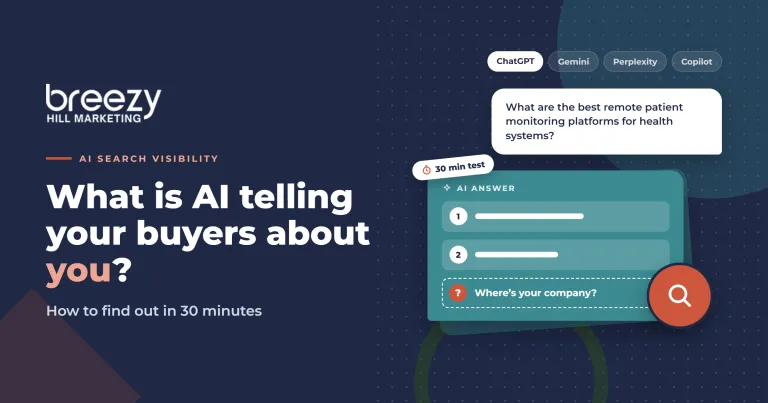
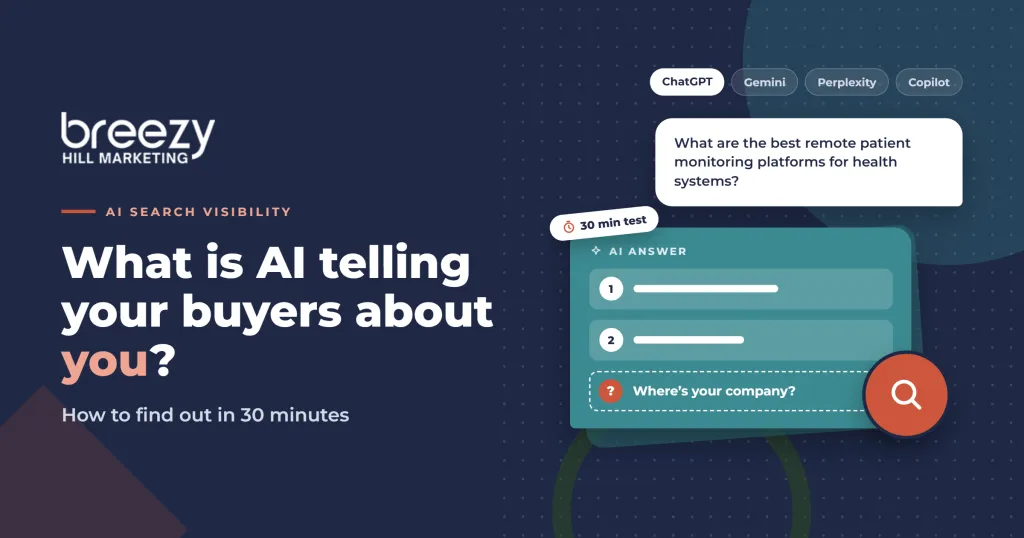
Quick answer: You can find out what AI tools say about your company by asking ChatGPT, Gemini, Perplexity, and Copilot the same five to eight category questions your buyers ask, then recording whether you appear, how you’re described, which competitors show up, and which sources are cited. The whole test takes about 30 minutes.
Why does it matter what AI says about your company?
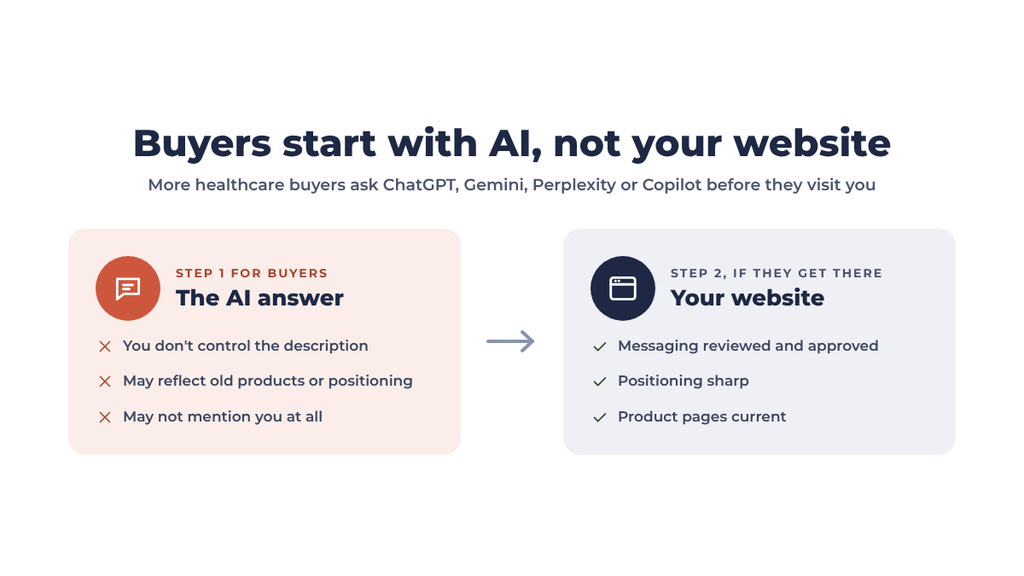
Your website describes your company exactly the way you want it described. But more and more healthcare buyers aren’t starting on your website. They start with a question typed into an AI assistant, and the answer may describe your company differently, or leave you out entirely.
How do you check what AI tools say about your company?
Step 1: List your buyers’ category questions (5 minutes)
Write down five to eight questions a buyer asks before talking to anyone at your company. Skip branded questions like “What is [your company]?” and use category questions, such as:
- “What are the best remote patient monitoring platforms for health systems?”
- “How do payers reduce prior authorization costs?”
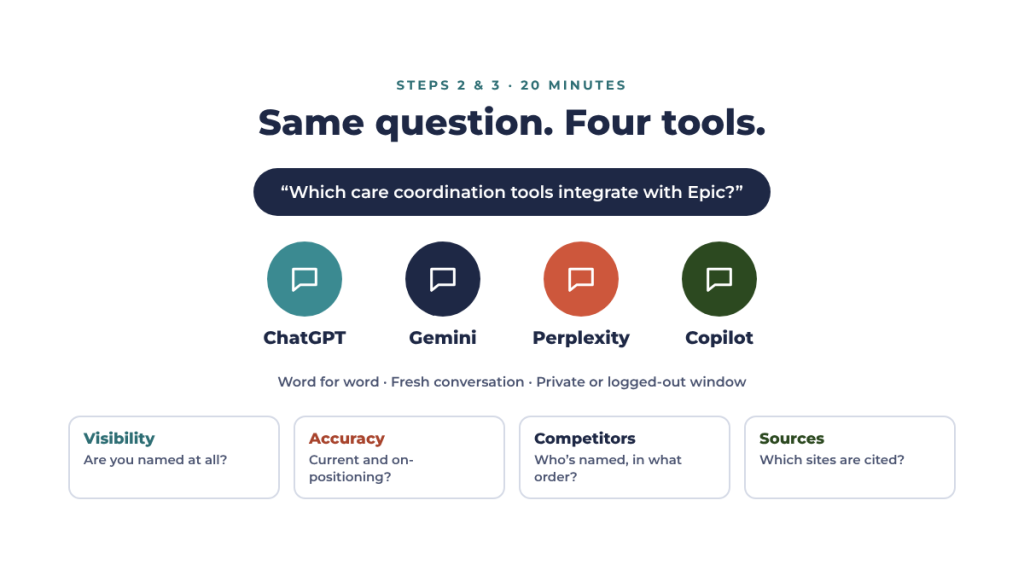
- “Which care coordination tools integrate with Epic?”
- “What should a health system look for in a patient engagement vendor?”

Step 2: Ask ChatGPT, Gemini, Perplexity, and Copilot (15 minutes)
Ask each tool every question, word for word, in a fresh conversation. Use a private or logged-out window where possible so past history doesn’t shape the results. In ChatGPT, a non-personalized Temporary Chat skips your memory and custom instructions.
Step 3: Record four things for each answer (5 minutes)
- Visibility: Are you named at all?
- Accuracy: Is the description current and in line with your positioning?
- Competitors: Who is named instead, and in what order?
- Sources: Which websites, publications, and listings are cited? (Perplexity includes numbered citations with every answer.)
Use a simple spreadsheet: one row per question, one column per tool. If you’re on HubSpot, its AEO analysis tools can help you track this over time.
Step 4: Diagnose the results (5 minutes)
| Result | What it looks like | Likely cause |
| Missing | You don’t appear for category questions where you belong | Too little clear, specific third-party content connects you to the category |
| Misdescribed | You appear, but the description is outdated or wrong | AI is drawing on old product pages, old positioning, or a single dated article |
| Outranked | You appear, but competitors are named first or described more favorably | Competitors show up in more of the sources AI tools rely on |
What can’t a 30-minute AI visibility test tell you?
The test shows symptoms, not causes. It won’t tell you why AI tools give these answers, which sources shape them most, or which fixes will have the biggest impact for the least effort.
That takes a deeper look across more questions, more competitors, and the full set of sources AI draws from, plus a review of how your own site and content are structured. Google’s guide to generative AI features in Search is a useful baseline for the site side, and we cover the content side in Why Your Content Won’t Win Healthcare Buyers in AI Search.
Your team owns the story. We help AI find it.
Your team knows your market, your buyers, and your story better than anyone. If the test turns up gaps, Breezy Hill Marketing’s Content and AEO team can help you decide what to fix first as part of your broader pipeline plan, so AI search gets the right share of your team’s time and no more.
Frequently asked questions
What is AEO or GEO?
Answer engine optimization (AEO) and generative engine optimization (GEO) are practices for improving how a company appears in AI-generated answers from tools like ChatGPT, Gemini, Perplexity, and Copilot.
Why use category questions instead of branded ones?
Buyers early in their research usually don’t know your name yet. Category questions show whether AI recommends you when buyers are still building a shortlist.
Why test in a private or logged-out window?
AI tools can personalize answers based on your history. A clean session gives you results closer to what a new buyer sees.
How often should I run this test?
Quarterly is a reasonable cadence, plus after major launches, rebrands, or positioning changes.
Have questions about your results?

Want help putting this to work?
We work alongside healthcare marketing teams. Discovery calls take 30 minutes.